American Air Hockey League Official Site
Welcome to the official AAHL Website — your go-to source for player rankings, updates, and the path to national championships. Whether you're a competitive pro or a passionate fan, you'll find the latest air hockey news and stats right here.
To view player rankings or check recent updates, just tap the “Rankings” or “Updates” button at the top of the page.
Want to join the AAHL and earn your own ranking?
Come to Jeremy's Downtown Arcade in Nampa, Idaho every Sunday at 5:30 PM MST for weekly tournaments open to all skill levels.
American Air Hockey League Rankings
Stay up to date with the latest player rankings in the AAHL.
The number in parentheses next to each player's name is their Rating — the higher the Rating, the higher their rank and division.
Click on any player's name to view detailed information about them.
Use the search bar to quickly filter players by name, location, division, or other details.
Note: If a player is ranked but doesn’t appear on the list, they may be archived due to inactivity (no matches played in the last 2 months).
American Air Hockey League Updates
Stay Up to Date with the Latest AAHL News. This page is your go-to source for official updates, announcements, and news from the AAHL. Whether it’s rule changes, upcoming events, or community highlights, you’ll find the most recent information about air hockey right here.
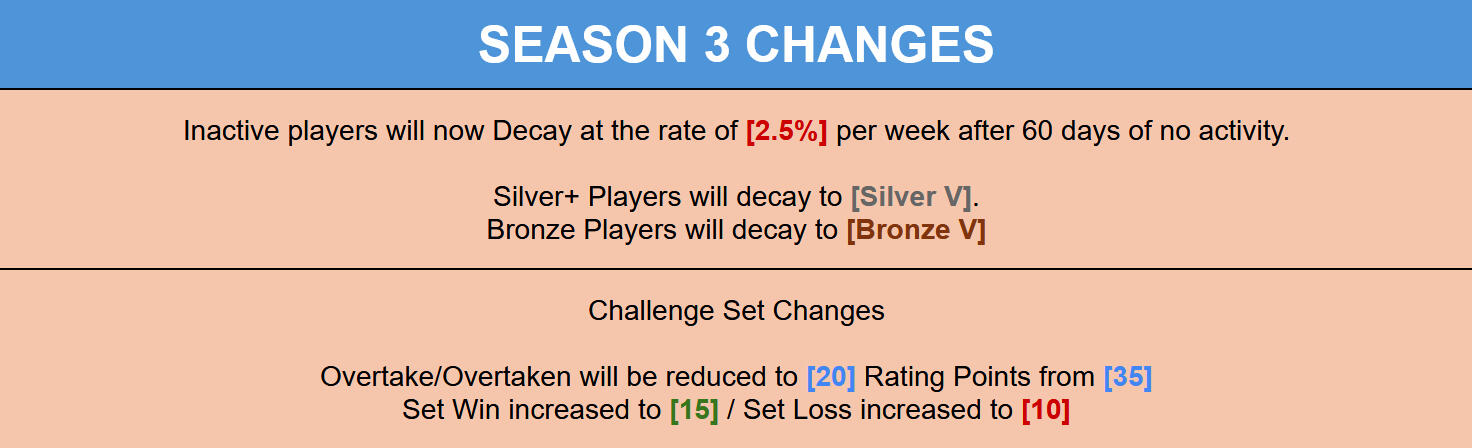
May 30 2025 - Season 3 Starts On June 1st and here are the changes
May 12 2025 - The American Air Hockey League Youtube Channel Reached 10,000 Subscribers
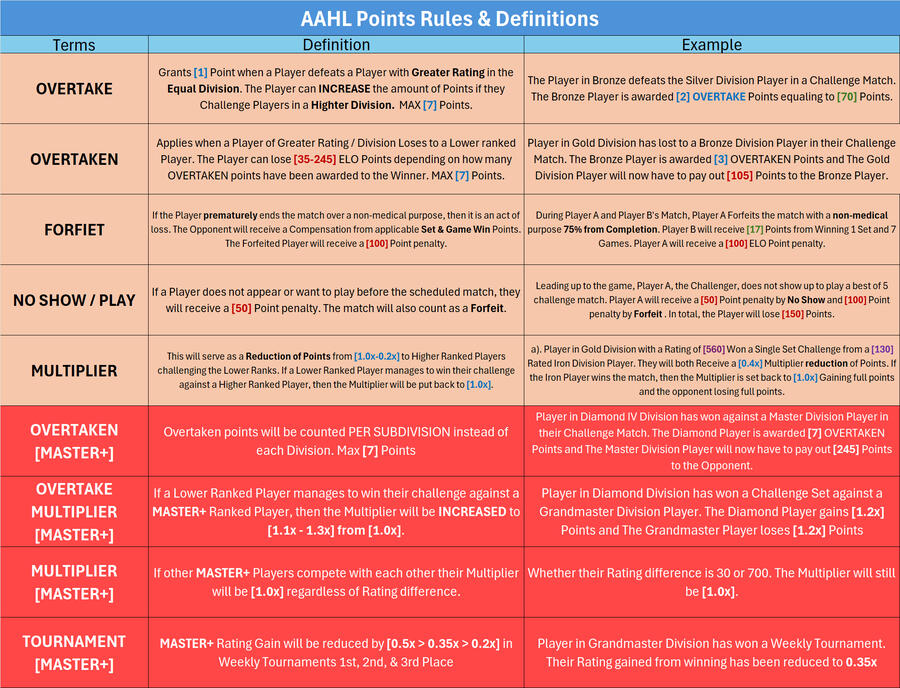
May 9 2025 - The Points Rules Were Changed For Rating.
May 8 2025 - This Website Was Created.
April 16 2025 - Biometrics Heart Rate Monitors Were Added To The Stream.
December 19 2024 - Scoreboard now shows Time Out and 2 Minute Break indicators.
American Air Hockey League Rules
Read the AAHL rules to learn how to play air hockey. Please note that these are the official rules of the USAA. If you're looking for the USAA rules, Click Here.
Section I. Basic Rules Of Play
The first player to accumulate seven (7) points wins the game.
When the puck enters and drops inside a player's goal, the player's opponent receives one point (unless play has been suspended by the referee or the offensive player had committed a foul during or prior to the shot.)
After each game, players will alternate table sides.
The player scored upon receives possession of the puck for the next serve.
A player may hand serve the puck only after it has entered the player's goal.
A player may play with only one mallet on the playing surface at one time. Violation results in a foul.
The puck may be struck with any part of the mallet.
The puck cannot be "topped" by lifting the mallet and placing it on the of the puck. This cannot be done at any time whether before a serve or or after a serve during play. Violation constitutes a foul. Using the mallet to bring an airborne puck to the table or opponent's goal is not a topping violation no matter which side or edge of the puck is contacted.
Only one puck may be in play at a given moment.
A player has seven (7) seconds to execute a shot, which crosses the centerline. The seven (7) seconds begins as soon as the puck enters and remains on that player's side of the centerline. Violation of this rule is a foul. the first violation of [the 7 second rule] by a player in a mach is a warning; subsequent violations in the same match will result in a foul.
When the puck is in contact with any part of the centerline, either player may strike the puck.
A player may stand anywhere around the table on the player's side of the centerline. The player may not stand past that line.
If any part of a player's hand, arm, body, or clothes touches the puck, "palming" will be called by the referee, which constitutes a foul.
Each player may take one 10 second time-out only when the puck in the player's possession or not in play.
A player must make a clear indication of time-out so that the referee understands the player's intention.
When a player is scored upon, the player will have ten seconds to remove the puck from the goal and place it in play. The ten seconds start as soon as the puck has fallen completely through the goal and is available for the player to place into play. This rule is suspended during the course of a time-out
Section II. Legal Objects
A. Sanctioned Tables
All Sanctioned tables must meet AAHL standards.
a. List of Approved Tables (full-size models)
Brunswick Blue Top
Dynamo Brown Top
Dynamo Blue Top
Dynamo Purple Top
Dynamo Photon (Ice-Blue Top) w/ thin centerline
Dynamo Pro-Style
Dynamo Best Shot
Gold Standard Games Classic Pro
Gold Standard Games Classic Plus
Gold Standard Games Classic Elite (Sanctioned under white light)
Gold Standard Games Classic Premium
Gold Standard Games Gold Flare Plus
Gold Standard Games Gold Flare Elite (Sanctioned under white light)
Gold Standard Games Gold Flare Premium
Gold Standard Games Tournament Pro
Gold Standard Games Tournament Pro Plus
Gold Standard Games Tournament Pro Elite (Sanctioned under white light)
Gold Standard Games Tournament Ice
All Gold Standard Gold Pro and Gold Flare Home models
b. Tables must be broken-in
"Conditional Approval" may be granted on a situational basis by the AAHL. This means that both player must agree to play on the table.
Tables with a long overhead light are not sanctioned for tournament use
B. Mallets
Mallets (strikers) must be approved by game referees as meeting the requirements of the AAHL. The AAHL requirements are as follows:
Weight must be 6 oz. or less
Diameter must be less than 4-1/16".
Hight must be between 3/4" inches and 4-1/16 inches
Color may be any except that the outside rim must be of a different distinct color than game surfaces of table.
The mallet must consist of the same material and be uniform and symmetrical throughout its circumference up to the normal hight of the puck on the table.
No mallet may be altered by sloping the playing surface in order to create an angled striking or defending surface.
C. Pucks
Three pucks are approved by the AAHL for sanctioned events: The "lexan-yellow", the "lexan-red" and the "Dynamo green". The "lexan-yellow" will be used unless both players agree to use another puck.
Pucks may not be changed during a game unless both players agree or unless the referee insists due to clear non-playability of the puck. Such a change in pucks must, if possible, be to the same kind of puck.
Pucks must have a clear bottom and top side. Play must always begin with the top side facing up and bottom side facing down.
D. Other Objects
Shields are approved for play if they are at a right angle to the top of the table and both players agree to play with them.
Devices for attaching mallet to hand (i.e bands, straps, strings, handles, and/or gloves) are legal as long as they do not affect the puck during play.
Section III. Beginning the Game
If players do not agree on the players starting sides, a coin toss is first used to determine starting sides. The player winning the coin toss chooses which side to begin the match on.
Every official match begins with a face-off. A face-off will be used for starting off every game game of the match unless both players agree to not have a face-off every game.
When there is only one face-off for the match, the winner of the face-off will begin the remaining odd numbered games with the puck. The opponent will begin even numbered games with the puck. Every game after the first begins when the referee calls "in play" after ascertaining that both players are ready. In case of any excessive delay by either player to give an affirmative indication of their readiness the referee will proceed to call "in play".
A face-off is when the puck is placed flat on the center of the table by the referee with the players allowed to advance to within one inch of the puck. A player's mallet may not touch the centerline until the referee releases the puck, at which time normal centerline rules will be in effect.
Once both players are positioned, the referee will call "players ready" then wait up to four (4) seconds before releasing the puck. When the referee releases the puck, the puck is in play.
If either player contacts the puck before the referee releases it than a false start has been committed then the innocent player receives possessionThe following constitute winning a face-off: A score on the opponent or gaining the first clear possession without fouling. A puck that has not yet left the centerline cannot constitute possession for either player.
During any face-off at the center of the table, the centerline rules are still in effect.
Section IV. In Play vs. Out of Play
The legal bounds of play are the table's playing surface, the walls of the rails, the front faces of the goals, the interiors of the goals, and the player's mallets. If the puck touches any other object(s) while it is in play, whether by interference of by foul (unless the foul is nullified) it is considered out of bounds and therefore instantly out of play.
A puck, which grazes the top of the rail, is out of play even if it returns to the table surface. If the puck bounces off a shield and returns to the table, the puck is out of play. If the puck gets hit in between the opponents goal and the railing then the player who hit that puck will get possession of it.
When the puck is in play, the referee should only grant a time-out if the player calling time-out demonstrates control of the puck. A puck breaking the vertical plane of the goal face can never be considered controlled. A puck breaking the vertical plane of the goal face can never be considered controlled. A player must never assume that the referee has granted a time-out and should therefore stay at the ready until the referee officially calls time-out.
If interference occurs during a shot which scores and interference is called by the referee, the point does not count. Interference is defined as a foreign objects on the table or playing surface, obvious unnecessary noise or distractions or actions by spectators that cause distractions to any or all players, and/or any other incident so deemed by referee. The puck returns to the player who possessed it prior to the interference.
When the puck leaves the playing surface and contacts anything except a player's mallet, play is suspended until the puck is put back into play by the referee. True, even if it touches top of flat rail surface.
Section V. Scoring
If the puck stops in the goal yet has tilted and broken the horizontal plane of the goal then a score has occurred. If a puck stops in the goal and does not tilt, thereby not breaking the horizontal plane, then the player may either hand the puck to the other player or try to work the puck out of the goal using legal play methods.
a. If the 7 second clock expires before the player is able to work the puck out of the goal, then the 7 second warning (for the first violation in a mach, see Rule I.10) is suspended and possession of the puck goes to the other player.
If the puck rebounds out of the goal mouth, the point does not count. A puck which rebounds out of the goal mouth and strikes the defending player's hand, and rebounds back into the goal does not count.
If a puck hits a player's hand on its way into the goal, the point counts as long as the puck would have scored without the contact.
If a score occurs after the table loses power, the point will count only if the puck was stuck prior to the table loosing power.
If a player takes a shot, looses possession of the mallet, and the puck enters the offensive player's goal for a score without being deflected by the defensive player, the point counts. When the mallet possession is lost, the offending player is permitted to stop the puck with the player's hand or body. No point is scored if the puck enters the opponent's goal due to the distraction.
If a player takes a shot and the defensive player looses possession of the mallet, the defense may not use hands or body to stop the shot if the shot occurred prior to or simultaneously with the loosing of the mallet. The point counts if it scores
If a player commits a foul and is scored upon in the course of the same play the goal counts and the penalty is nullified.
Section VI. Penalties & Fouls
Foul: The penalty for a foul is forfeiture of the puck.
Technical Foul: The penalty for a technical foul is a free shot, play immediately begins when the puck either scores, rebounds from the goal, touches the opponents's end of the table (not sides), or comes to a rest on the playing surface. All free shots must be legal.
Unnecessary or excessive delay of game is considered a foul and a loss of puck results. Stalling is included in this ruling of delay (referee decision).
If the puck rises from the table and touches the defensive player's hand(s) or arm(s), no foul need be called, the game is still in play.
If an offensive player hits a puck and the puck wobbles, hitting the hand of the defensive player, but not changing the perceived speed and direction of the puck, then no foul occurs.
"Goal-Tending": If "palming" occurs while the puck is moving in a direct path towards the goal for a score, "goal-tending" must be called against the player doing the "palming." "Goal-tending" incurs a technical foul.
When a player loses control of the mallet while the puck is in play the player commits a foul. If a player's hand looses contact with the mallet but a device (e.g., strings) remains attached to both the mallet and the player's hand/finger, then there is no foul and play continues.
When the puck is struck in an offensive manner, leaves the playing surface, and remains off the table, the player causing such action commits a foul.
Any player violating a centerline rule commits a foul.
Distractive Noise: Talking to an opponent, a spectator, a referee, or oneself during play may be penalized by a foul. Loud noises and excessive screaming can also be considered distracting. A referee may warn a player before calling a foul at the referee's discretion. Intentional or excessive, distractive talking may be penalized by a "conduct warning" in addition to a foul. Possible distraction violations, which directly lead to a score or a change of possession, should be scrutinized more seriously by a referee when determining whether to ignore, warn or penalize the potential violation.
If the puck and mallet of the offensive player are both completely on the offensive player's side, the defensive player may not strike either the puck or mallet unless in a nice way to hand the mallet back to the player with no damage to the mallet. Also, the offensive player may not strike the defensive player's mallet. Also, the offensive player may not strike the defensive player's mallet in this situation when the defensive player's mallet is completely on the defensive player's side. Violation of this rule constitutes a foul.
If in the course of hitting the puck legally, a player's mallet extends partially (but not completely) over the centerline, no foul shall be called if the player's mallet contacts the opposing player's mallet.
Although a mallet is allowed to overreach the centerline, the mallet may never completely extend over the centerline -- even when following through on a shot. The mallet may never extend further than its diameter across the centerline. Violation of this rule constitutes a foul.
Any player who, on a hand serve, makes a score in the opponent's goal without there having been an offensive shot made on the puck, since the time that the puck was in play, commits a foul of tossed score. In other words, a player cannot just toss the puck into the opponent's goal. The illegal score shall not create a point, and the player who was illegally scored upon shall have the right to hand serve as the penalty imposed upon the fouling player.
If the defensive player strikes the puck an offensive manner (with forward momentum) and causes the puck to leave the playing surface, this constitutes "charging the puck". The offensive player retains possession of the puck, Conversely, a defensive player who "blocks" by holding steady or by striking the puck sideways or backwards, causing the puck to leave the table, should not be charged with "charging."
If the referee decides that excessive force was used by the defensive player in knocking the puck off the table, the player commits a foul
Section VII. Player Conduct
UNSPORTSMANLIKE CONDUCT WARNING: A foul is incurred upon the second conduct warning received in a match. A technical foul is incurred upon the third conduct warning received in a match. A fourth conduct warning resaults in forfeiture of the current game. A fith conduct warning resaults in forfeiture of the match. A referee issues the conduct warnings immediately but must wait until after the game to record the details on the back of the match card. Actions that should receive "conduct warnings" include, but are not limited to:
a. Excessive or abusive arguing with the referee
b. Cursing directed towards the referee
c. speaking loud and vulgar obscenities
d. Verbal or physical assault of another player, spectator, or referee
e. Actions that endanger spectators
f. Destruction of property
g. Actions that discredit the sport, as decided on by the AAHL
h. Taunting of another player (includes but not limited to: cursing your opponent, verbally defaming them, or making obscene gestures)
i. Intentional or excessive distracting noise
If a referee feels a player has committed extreme unsportsmanlike conduct, the referee may issue multiple "conduct warnings" for one single action. A referee may issue enough "conduct warnings" to cause a forfeiture of a game or match immediately if the referee feels the penalty is warranted.
Section VIII. Player Rights
Players of a Challenge Match may play without a referee at their own risk of irreconcilable controversies.
Before competition begins, a player has the right to play under the stipulation that no special time-outs for the purpose of clearing sweat from the table. Unless a player requests this stipulation from the referee either player may request the referee to clean the table during a game.
If a referee coaches a player or engages in any questionable behavior, the opposing player may protest to a Head Referee or ultimately to the Tournament Committee for a decision.
An appeal may be made from either player not in agreement with the referee's decision. However, the appeals from an Official Air-Hockey Competition and a Challenge Match go to different bodies.
a. The appeal goes to the Head Referees in an Official Air-Hockey Competition. The Head Referees may overturn the original referee's decision only if the matter is an incorrect understanding of the rules. After the correct rule is understood, the original referee's interpretation of the evidence according to the rules if final. The appeal in this situation must be made immediately after the occurrence of after the end of the game in which the disagreement took place. When the next game is begun, no appeal may be made.
b. The appeal goes to the AAHL, after a challenge match. These directors decide whether the appeal is valid and, if so, have the right to make any decisions they deem necessary.
If a player desires spectators or players to be quieter while playing, the player should ask the referee to request quiet from the crowd. If the referee does not believe the noise to be unusual, then the referee does not have to request the quiet. The player desiring quiet must not abuse the crowd.
During a challenge match players have a maximum of one minute in between games, however either player may choose to take one 2 minute break in between games each set. This may be extended in emergencies.
A player is allowed to change mallets at anytime during play.
If a puck is flipping around on its edge on one player's side of the table, then the player may wait for it to stop.
Section IX. Player Rights
Each game in a AAHL Sanctioned Air Hockey Tournament shall be refereed. The referee will act as an unbiased observer insuring that the game is played in a correct, fair, and sportsmanlike manner.
The referee has the authority to declare "in play", "time-in", or "time-out". The referee has the authority to impose penalties and enforce all the rules of the sport.
The referee must never coach a player from the match the referee is officiating.
When the game is out of play as a result of a foul the referee will ask the player not in possession of the puck if that player is ready before the referee announces "in play" (or "time-in"). In case of any excessive delay by the player not in possession of the puck to give an affirmative indication to the referee that the player is ready, the referee may proceed to put puck in play. The referee must place a puck that is off the table back into play by either physically releasing it or by acknowledging the release of the player.
The referee has the final word on any decision during the game that is in adherence to the rules. The referee may consult others if the referee wishes to do so.
Referee may call an official time-out of a reasonable duration if the referee agrees that the situation warrants if (e.g., sanding the puck, interference, emergencies).
Referees should caution players to desist from striking pucks that are obviously spinning top-like on the table. A foul may be called. Such pucks may be kept on the table by use of the mallet.
If a referee doesn't suspend play immediately after a foul, but the referee's voice or gesture interferes with continued play to the point of distraction, the puck should be returned to the player not committing the foul. A player must never assume that a foul will be called and stop play. The puck remains in play until the referee suspends play and then decides the nature of the foul and the moment of play in which it occurred.
If a puck is flipping around on its edfe on one player's side of the table, then the referee will suspend the seven-second rule until the puck rests flat.
Lifting the mallet from the table and striking the puck is legal. However, if the referee can show clear damage to the table, the player causing such damage to the table must cease use of whatever method of play causes it. The referee may also at any time disallow a technique that is deemed destructive to property or dangerous to players and/or spectators.
The referee shall verbally state the score of the game after each point is scored. The referee shall also verbally declare the game count of the set after each game is completed, and set counts after each set, if applicable.
If a foul occurs and the innocent player plays the puck before the referee has time to suspend play and grand the innocent player possession of the puck, the referee may choose not to call the foul.
The referee should caution players not to tilt the player's mallets so as to descend past a 40 degree angle when touching the puck with the mallet. Otherwise, their action can be considered "topping" the puck, which incurs the penalty of a foul.
In the case of a centerline or topping violation, the referee shall not stop play if the innocent player gains immediate possession of the puck.
If during the course of play the puck flips so that no layer of tape appears on the side of the puck facing up, the referee must suspend play as soon as the current play resolves.
a. Resolution of play occurs when a player demonstrates clear, controlled possession of the puck.
b. After the puck is positioned correctly (Section II.C.3) The referee will resume play in normal fashion (Section IX.5)
Ok so you inspected the code and found this good job you know a tiny bit about webpages (I did not hide it that much)
WHY STOP BEING ON MOBILE GO ON A COMPUTER IT LOOKS BAD ON MOBILE